
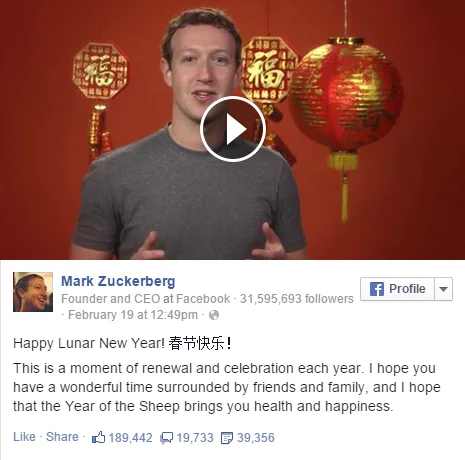
Archive: February 2015. Mark Zuckerberg shared a short Lunar New Year greeting in Mandarin in February 2015. In the accompanying English text, he wished viewers time with friends and family and health and happiness in the Year of the Sheep. The video was a personal social-media message, not a Facebook product announcement or a demonstration of a language-learning app.
What the greeting showed
The clip drew attention because Zuckerberg had been studying Mandarin and had spoken the language publicly during a 2014 visit to Tsinghua University in Beijing. The 2015 greeting was another brief public use of Mandarin. It should not be described as proof of fluency: a short prepared greeting gives only a small sample of a person’s speaking ability. Contemporary coverage recorded the post and its timing, but assessments of pronunciation or proficiency are subjective and should be attributed rather than presented as fact.

The English message placed the greeting in a family and community context. Lunar New Year is observed by many communities and traditions across Asia and around the world. Naming the year in the Chinese zodiac was relevant to the specific 2015 celebration, but the broader holiday is not exclusive to one nationality. Using the term “Lunar New Year” keeps the article’s framing inclusive and accurate.
Mandarin learning and public communication
Learning a language involves more than memorizing greetings. Pronunciation, tones, listening, reading, and conversational practice all matter, and progress differs among learners. A short message can still be meaningful as an effort to communicate with an audience in its language. Zuckerberg had previously explained publicly that he studied Mandarin for personal reasons and used it in a university discussion. The greeting fits that longer public record, while it does not tell us how much practice or preparation went into that particular recording.
There is also a difference between language practice and a corporate strategy. Analysts sometimes interpreted public Chinese-language appearances in relation to Facebook’s interest in China. That is commentary, not a confirmed explanation for this holiday video. This rewrite avoids claiming that the greeting was intended to secure business access or influence policy without a direct statement establishing that purpose.
Finding the original post
The original Facebook post may no longer be easy to view because platform interfaces, privacy settings, and media availability change. The original article’s image is not the video itself. If an editor embeds the clip, confirm it is the authentic post, works on mobile, and remains publicly available. Do not replace it with an unrelated repost without clearly identifying the source and checking reuse rights.
As a technology archive item, the story records how a social platform carried a personal message to a large audience. Its enduring interest lies in the intersection of language learning, public communication, and social media distribution—not in an unsupported claim about perfect fluency or company policy.

