
NVIDIA announced Tegra K1 in two CPU configurations: a 32-bit quad-core Cortex-A15 version and a custom 64-bit dual-core CPU it called Denver. Both used graphics based on NVIDIA’s Kepler architecture. NVIDIA described Denver as ARMv8-compatible and projected it for devices in the second half of 2014.

Correcting the Nexus tablet reference
The old headline predicted that Denver would power a “Nexus 8.” Google and HTC released a tablet named Nexus 9 in 2014, and HTC’s historical materials identify Tegra K1. A rumor about a product name should not be repeated as confirmed hardware. The chip announcement and tablet release were related in coverage but do not validate every forecast in the original article.
Why the processor drew attention
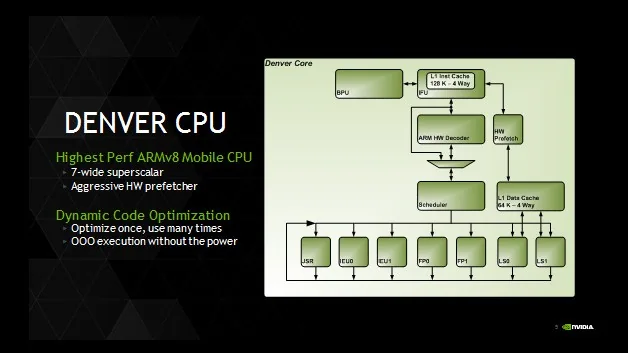
The Denver configuration used NVIDIA’s custom CPU design, unlike the Cortex-A15 cores in the other K1 version. NVIDIA paired it with mobile graphics based on Kepler. The announcement reflected the transition toward 64-bit mobile platforms. Specifications alone do not predict real-world performance: cooling, memory, power limits, software optimization, and workload all matter.
A claim such as “world’s first” needs a clearly defined category and evidence. Several platforms were evolving at the same time, so this rewrite avoids a broad first-place claim. NVIDIA’s announcement supports the K1 variants and expected timing; HTC’s materials establish the Nexus 9 context.
What readers should take away
Tegra K1 is a legacy processor, not a current Android recommendation. The story shows how hardware launches can be mixed with rumors and ambitious claims. Anyone researching the tablet should use its correct name and device documentation. Current buyers should compare supported devices and recent benchmarks rather than rely on 2014 announcements.

