
Web tools that estimate age from a face photograph can be entertaining, but their results are not a reliable statement of a person’s actual age. Before uploading a selfie, check what happens to the image, whether the service keeps it, and whether it uses the photo for other purposes. A face image can be personal data, and depending on how it is processed it may also raise biometric privacy questions.
Understand what an estimate can and cannot tell you
Age-estimation software analyzes visual patterns in a face and produces a prediction. It does not read a birth record or verify identity. The U.S. National Institute of Standards and Technology evaluates age-estimation algorithms and reports that performance can vary with image quality, the person’s age, sex, and region of birth. NIST has also found demographic differences in error rates. It explicitly does not recommend whether a particular algorithm is suitable for a particular use. A playful estimate from one photograph should therefore not be treated as fact, used to make a consequential decision, or compared as if every person were measured under identical conditions.
Review privacy before uploading
Look for a clear privacy notice that explains who operates the service, whether the photo is stored, how long it is retained, whether it is shared with third parties, and how to request deletion. Check whether the site requires an account, asks for unnecessary profile information, or allows images to be used to train or improve a model. If these details are unclear, do not upload a recognizable face. Use a synthetic image or skip the service.
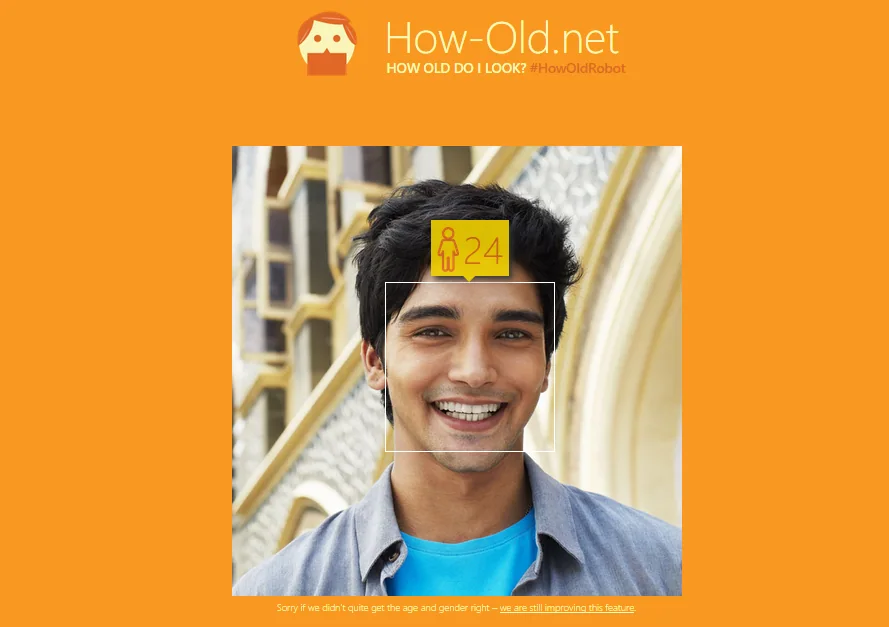
Be especially careful with children’s photographs. Do not upload someone else’s image without permission, and avoid posting the result publicly with their name, school, location, or other identifying details. An age guess can be wrong and may embarrass or misrepresent the person.
Do not confuse age estimation with identity verification
Age estimation and face recognition are related forms of face analysis, but they are not the same task. A tool that guesses an age is not proving who someone is or confirming that they meet a legal age threshold. The UK Information Commissioner’s Office has discussed privacy considerations in age assurance, including face-based and profiling approaches. Its guidance is jurisdiction-specific, but it is a useful reminder that context, necessity, transparency, and safeguards matter when systems infer age.
Use a safer sharing approach
If you choose to experiment, use a non-sensitive image, read the service’s terms first, and avoid linking the result to a public profile. Do not use the tool to judge people or make decisions about access, employment, school, credit, or safety. If you already uploaded a photo and want it removed, follow the service’s official deletion process and revoke related permissions where possible.
The old service linked in a 2015 article may no longer operate, and current face-analysis tools have different operators and privacy practices. Check each tool individually. A prediction is only as dependable as the model, image, and context—and keeping a face photo private is often the simplest choice.

